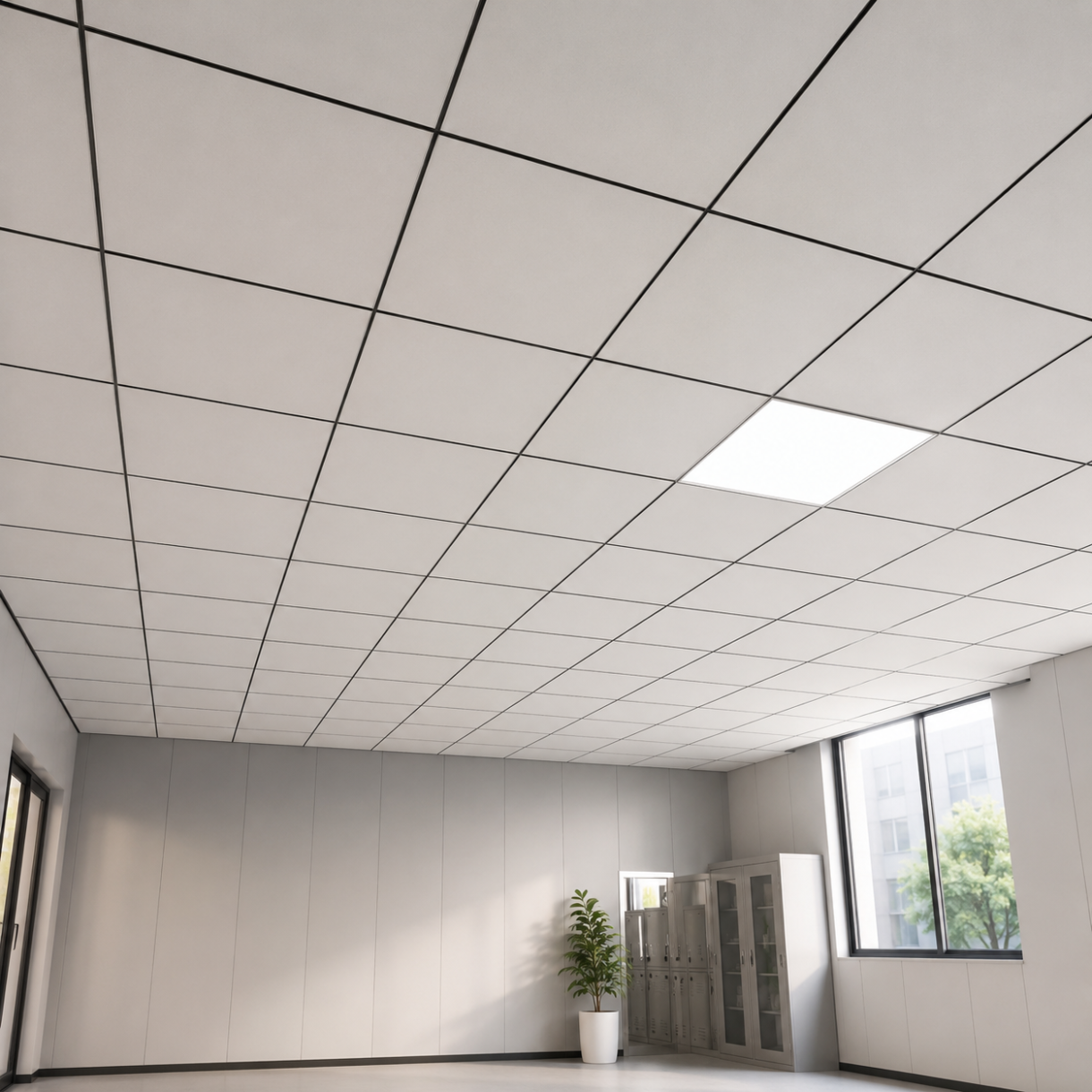





Reduce Echo and Ceiling Sag with Fiberglass Acoustic Panels
Modern buildings—including offices, hotels, schools, hospitals, cinemas, shopping centers, and transportation hubs—frequently use glass, concrete, metal, and stone. Although these materials create a clean and contemporary appearance, their hard surfaces reflect sound waves throughout the room.
Repeated sound reflections can cause excessive echo, prolonged reverberation, poor speech intelligibility, and an uncomfortable indoor environment.
Humidity creates another common problem. Traditional ceiling materials may absorb moisture, resulting in staining, deformation, edge damage, or gradual ceiling sag. These issues increase maintenance costs and negatively affect the appearance and service life of the ceiling.
XIAO HENG fiberglass acoustic panels are designed to address these challenges. With a Noise Reduction Coefficient (NRC) of approximately 0.90–0.95, Class A1 fire-rated options, moisture resistance, dimensional stability, and lightweight construction, they provide a reliable acoustic ceiling and wall solution for modern commercial projects.
Why Do Modern Buildings Experience Echo and Noise Problems?
Sound waves travel through a room until they reach a surface. Soft and porous materials absorb part of the sound energy, while hard materials reflect most of it into the room.
When a space contains large areas of glass, concrete, metal, stone, or other reflective materials, sound reflections accumulate and may cause:
- Excessive echo and reverberation
- Reduced speech intelligibility
- Difficulty hearing conversations
- Poor communication in meeting rooms and classrooms
- Increased background noise
- Reduced concentration and workplace comfort
- Lower-quality audio recordings
Installing sound-absorbing materials on ceilings and walls helps reduce these reflections, creating a quieter, clearer, and more comfortable acoustic environment.
How Do Fiberglass Acoustic Panels Work?
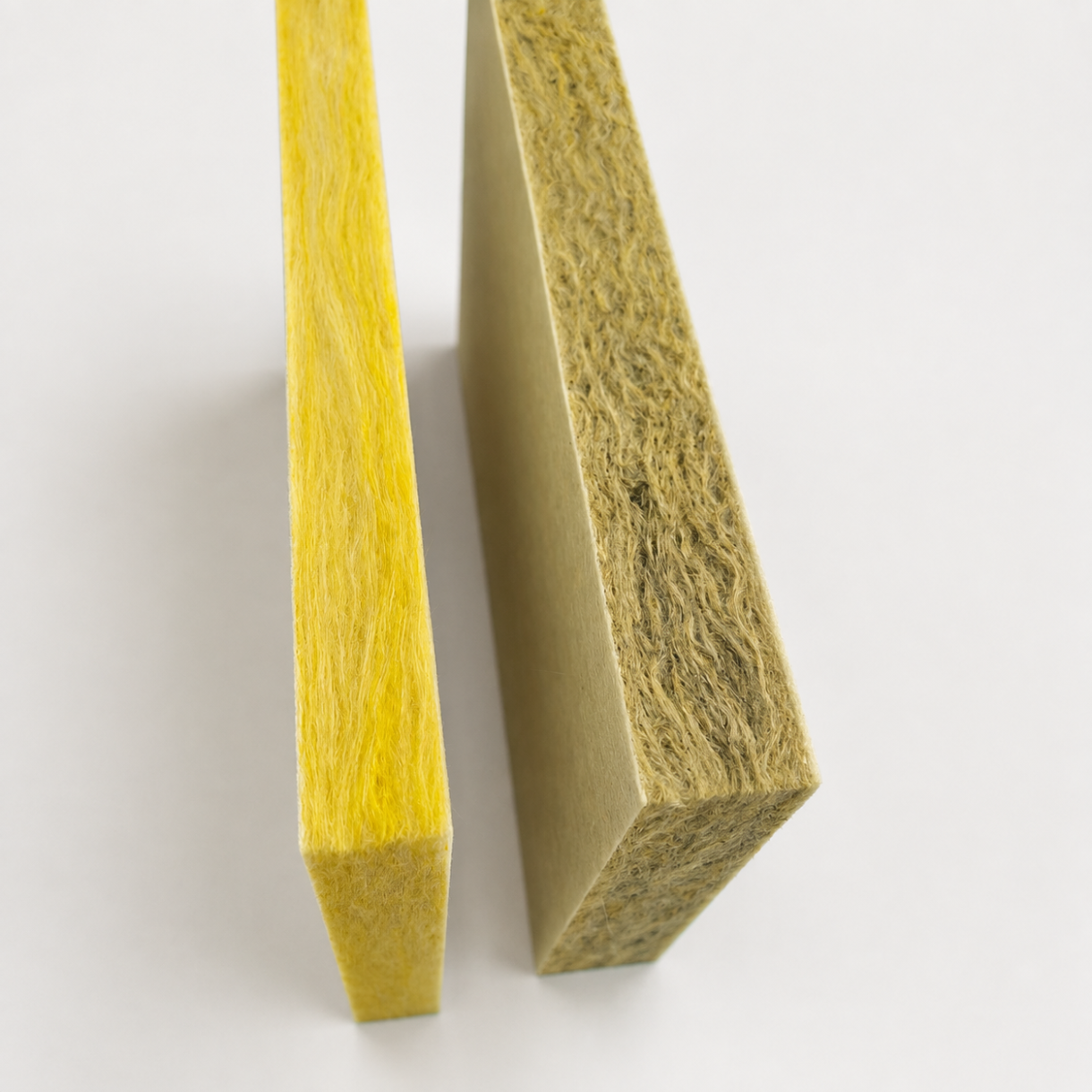
Fiberglass acoustic panels are manufactured from fine glass fibers that form a lightweight and porous board. Their interwoven structure contains countless tiny air pockets.
When sound waves enter the panel, air moves through these small spaces. Friction between the moving air and the glass fibers converts part of the sound energy into a very small amount of heat. As a result, less sound energy is reflected into the room.
This porous absorption mechanism makes fiberglass acoustic panels effective at reducing:
- Echo
- Reverberation
- Reflected sound
- Excessive background noise
Depending on the architectural design, the panel surface may be finished with decorative fiberglass tissue, acoustic fabric, paint, or another sound-permeable facing material.
NRC 0.90–0.95 for High-Efficiency Sound Absorption
The Noise Reduction Coefficient measures a material’s ability to absorb sound under specific test conditions. An NRC of 0 indicates almost no sound absorption, while an NRC close to 1.00 represents extremely high sound absorption across the tested frequency range.
Depending on the product configuration, XIAO HENG fiberglass acoustic panels can achieve NRC values of approximately 0.90–0.95.
Actual acoustic performance may be affected by:
- Panel thickness
- Panel density
- Surface finish
- Installation method
- Air cavity behind the panel
- Distance from the structural ceiling
- Frequency range and testing standard
For example, under specified laboratory conditions, a product with an NRC of 0.90 absorbs an average of approximately 90% of the sound energy used to calculate the rating.
This performance makes the panels suitable for offices, classrooms, cinemas, conference rooms, restaurants, hotels, studios, and other spaces requiring better speech clarity and reverberation control.
Sound Absorption vs. Sound Insulation
Sound absorption and sound insulation are related but different concepts.
Fiberglass acoustic panels primarily control sound reflected inside a room. They reduce echo and reverberation, making speech and music clearer and the space more comfortable.
Sound insulation—also known as soundproofing—aims to reduce sound transmission through walls, floors, and ceilings into neighboring rooms. Effective sound insulation normally requires a complete system containing high-density layers, sealed joints, resilient framing, air cavities, and appropriate sound-insulating materials.
Therefore:
- Use fiberglass acoustic panels to improve the acoustic quality inside a room.
- Use complete soundproof wall panels or ceiling systems to reduce sound transmission between rooms.
- Combine both systems when a project requires reverberation control and acoustic privacy.
Understanding this distinction helps contractors and project purchasers select the correct system and avoid unrealistic performance expectations.

Class A1 Fire-Rated Options for Safer Buildings
Fire performance is critical for products installed across large ceiling and wall areas.
Fiberglass is inherently non-combustible. When suitable surface finishes, backing materials, coatings, and adhesives are used, the completed acoustic panel may achieve a Class A1 fire rating under the applicable testing standard.
Class A1 fire-rated fiberglass acoustic panels are suitable for:
- Hospitals and healthcare facilities
- Schools and universities
- Airports and railway stations
- Hotels and shopping centers
- Offices and public buildings
- Cinemas, theaters, and auditoriums
- Factories and industrial facilities
Fire safety requirements vary between countries and projects. Buyers should confirm whether the project requires EN, ASTM, GB, AS/NZS, TIS, or another local standard before production.
The fire report should correspond to the actual finished product because fabric, coating, backing, and adhesive selections can affect the final fire classification.
Moisture Resistance and Long-Term Sag Resistance
Humidity is a major challenge for ceiling materials, particularly in tropical regions, coastal areas, and buildings with continuously operating air-conditioning systems.
Some conventional ceiling materials absorb moisture and gradually lose dimensional stability. This may lead to deformation, staining, edge damage, or visible sagging.
XIAO HENG fiberglass acoustic panels offer several advantages:
- Excellent moisture resistance
- Reliable sag resistance
- Good dimensional stability
- Reduced maintenance requirements
- A clean and flat ceiling appearance
- Long service life in humid environments
These properties make them suitable for projects exposed to changing temperature and humidity conditions.
For exceptionally humid environments, buyers should confirm the required relative-humidity performance, panel finish, suspension system, and installation conditions before placing an order.
Lightweight Construction and Easy Installation
Fiberglass acoustic panels are lighter than many traditional ceiling and decorative materials. Their lightweight structure makes them easier to:
- Pack and transport
- Handle on the construction site
- Cut to the required dimensions
- Install in suspended ceiling grids
- Remove for above-ceiling maintenance
- Replace individually when necessary
Standard ceiling panels can be installed directly into exposed T-grid systems. Wall panels, ceiling clouds, suspended baffles, and custom-shaped panels may be installed with clips, frames, suspension hardware, or suitable adhesives.
The lightweight construction can reduce transportation costs, installation time, labor requirements, and structural loads.
Flexible Sizes, Colors, and Architectural Designs
Acoustic treatment should enhance the architectural appearance of a room rather than limit its design.
XIAO HENG offers panels with customizable:
- Dimensions
- Thicknesses
- Densities
- Colors
- Edge profiles
- Surface finishes
- Installation systems
Available product forms include:
- Square and rectangular ceiling panels
- Triangular and hexagonal wall panels
- Fabric-wrapped acoustic panels
- Black cinema ceiling panels
- Acoustic ceiling clouds
- Suspended acoustic baffles
- Three-dimensional decorative elements
- Custom shapes manufactured from project drawings
White panels create a bright and clean ceiling appearance for offices, schools, hospitals, and commercial interiors.
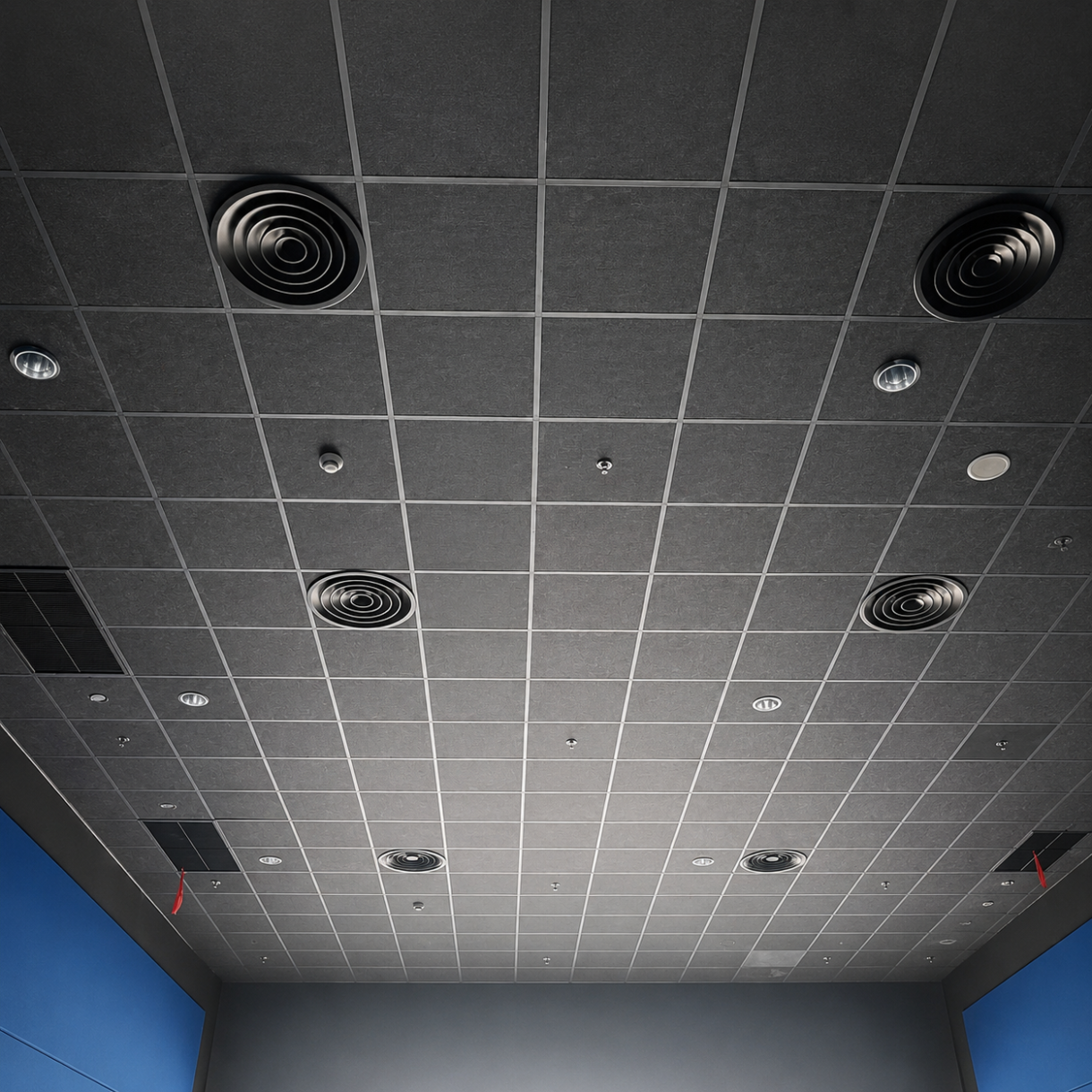
Black fiberglass acoustic ceiling panels are especially suitable for cinemas, home theaters, studios, karaoke rooms, bars, and exposed ceiling systems where low light reflection is required.
For creative interiors, custom fiberglass acoustic panels can be produced in different colors and geometric shapes, allowing architects to integrate acoustic performance into the overall design.
Typical Application 1: Open-Plan Offices
Project challenge
Open-plan offices often contain glass partitions, concrete floors, metal furniture, and other reflective surfaces. Conversations and telephone calls generate repeated reflections that affect concentration and communication.
Recommended solution
- Install high-NRC fiberglass acoustic ceiling panels.
- Use standard modular sizes compatible with the ceiling grid.
- Install wall-mounted acoustic panels in meeting and collaboration areas.
- Select white or light-colored finishes to maintain interior brightness.
Expected result
The system can reduce reverberation, improve speech clarity, enhance meeting-room communication, and create a more comfortable workplace.
The final result depends on room volume, existing finishes, acoustic-panel coverage, installation height, and background noise. Projects with specific reverberation-time targets should be evaluated by an acoustic consultant.
Typical Application 2: Cinemas and Private Home Theaters
Project challenge
Cinemas require effective control of sound reflections, reduced echo, minimal light reflection, and fire-safe interior materials.
Recommended solution
- Install black fiberglass acoustic panels.
- Use panels measuring approximately 594 × 594 mm for standard 600 × 600 mm T-grid systems.
- Select a typical thickness of approximately 20 mm or another thickness based on acoustic requirements.
- Coordinate ceiling panels with wall-mounted acoustic treatments.
- Confirm the required fire classification for the completed product.
Expected result
A properly designed system can improve reflected-sound control and speech intelligibility while reducing visual glare and maintaining a clean ceiling appearance.
Typical Application 3: Hotels and Commercial Buildings in Humid Climates
Project challenge
Traditional ceiling panels may absorb moisture and sag in high-humidity environments. Hotels and other public areas also require an appropriate balance of aesthetics, fire safety, durability, and acoustic comfort.
Recommended solution
- Use moisture-resistant fiberglass ceiling panels.
- Select corrosion-resistant suspension accessories where necessary.
- Confirm the building’s expected relative-humidity conditions.
- Choose washable or suitable decorative surface finishes.
- Combine acoustic panels with aluminum ceiling systems in areas with different functional requirements.
Expected result
The completed ceiling can provide better flatness and stability, lower maintenance requirements, improved acoustic comfort, and a professional long-term appearance.
What Do B2B Buyers Usually Consider?
Wholesalers, contractors, builders, and project purchasers typically evaluate the following factors.
1. Is the acoustic performance supported by test data?
Professional buyers need acoustic reports showing NRC, αw, or sound-absorption coefficients at specific frequencies. General statements such as “good sound absorption” are normally insufficient for engineering projects.
2. Will the panels sag in humid environments?
This is particularly important for tropical markets, coastal projects, hotels, restaurants, hospitals, and buildings with continuously operating air-conditioning systems.
3. Do the fire reports meet local project requirements?
A test report issued under one national standard may not automatically satisfy another market. Applicable standards and required reports should be confirmed before production.
4. Can the supplier maintain consistent dimensions and colors?
Batch consistency is essential for distributors and large construction projects. Variations in thickness, edge details, color, or surface finish can affect installation and the final appearance.
5. Can the manufacturer provide customization and stable bulk production?
Wholesalers and contractors may require:
- Project-specific dimensions
- Customized colors and finishes
- OEM or private-label packaging
- Mixed-color container shipments
- Technical documents and test reports
- Installation accessories
- Reliable production and delivery schedules
Confirming these requirements before production helps reduce installation problems, customer complaints, and replacement costs.
How to Select the Right Fiberglass Acoustic Panels
Before requesting a quotation, buyers should provide:
- Project type and installation location
- Ceiling or wall application
- Required panel dimensions and thickness
- Surface color and finish
- Ceiling-grid specifications
- Estimated order quantity
- Required fire and acoustic standards
- Project drawings or installation details
- Destination country and delivery schedule
This information enables the manufacturer to recommend a more suitable product structure, panel specification, installation system, and packaging method.
Why Choose XIAO HENG?
XIAO HENG supplies acoustic and decorative building materials for wholesalers, contractors, builders, and international construction projects.
Our services include:
- OEM and ODM production
- Customized sizes, colors, and edge profiles
- Fiberglass acoustic panels and aluminum ceiling systems
- Project-based product recommendations
- Supporting suspension grids and installation accessories
- Sample and technical-document support
- Export packaging and bulk-order production
Whether your project requires improved acoustic comfort, moisture-resistant ceilings, custom decorative panels, or a combination of acoustic and metal ceiling systems, XIAO HENG can provide a solution based on your drawings and technical requirements.
Request Samples or a Project Quotation
Are you looking for reliable fiberglass acoustic panels for a commercial, educational, hospitality, healthcare, cinema, or public-building project?
Contact XIAO HENG to request product samples, technical information, or a customized quotation for your next project.